

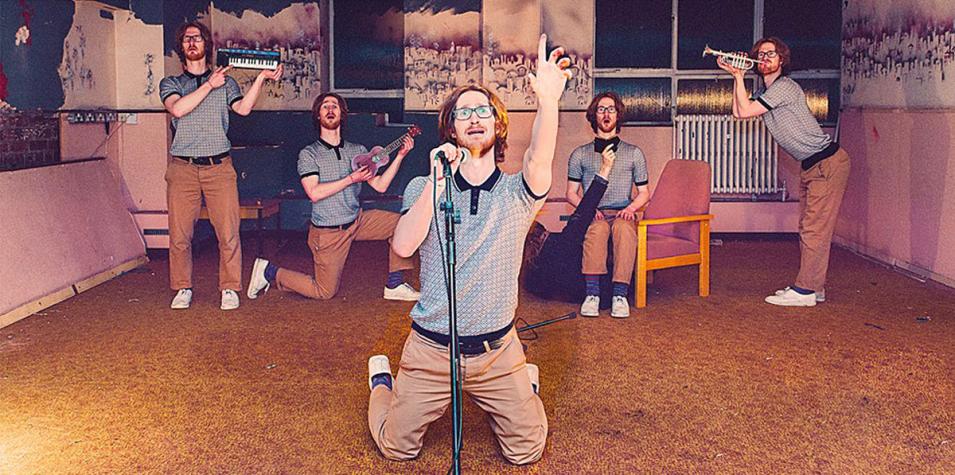
Calling all StageSider’s, welcome to our first (hopefully of many) interviews here at StageSideUK. For now, it is text based, but who knows what may happen in the future….. We got to ask Andy Owen Cook, the writer and artistic director of Forest Sounds Theatre, a couple of questions about the company, their show Person Spec and their visit to the Alphabetti Theatre in Newcastle. So lets jump straight into the first question.
Could you tell me a bit about yourself, your role and a background into the work of Forest Sounds Theatre Company?
Hi there! I’m Andy Owen Cook, writer and artistic director of Forest Sounds Theatre.
FST is a collaborative company from the North of England. We make performances that use a live event to explore political and social contexts. That is to say, we’re interested in how we treat others, and how we treat ourselves.
Our shows are all boldly experimental and foster a sense of the unknown wherever they take place. The shows place an audience in the centre of surreal worlds that slowly opens up around them.
At the same time, we aim for widespread popularity. It’s our mission to win people over. We want to share our work with all people, especially those who think ‘experimental’ ‘contemporary’ theatre isn’t for them. It helps that we really like making people laugh.
Person Spec is a very unique show, putting the audience in charge of facilitation. Where did this idea come from?
The work we make always places the audience in an active role. We want to push the boundaries of theatrical conventions and the relationship with the audience is one that has always fascinated us. We think of them as our co-conspirators, even if they aren’t totally sure what their role is.
Using a job interview came out of enjoying ‘Autotheatre’ – audience-led work by Ant Hampton & Silvia Mercuriali and Work.txt which was a great recent show in that genre. I started writing the show after being made redundant twice and graduating into a global recession. In-between job applications I started thinking, “I wonder if we could get audiences to…”.
It comes from the fear and joy of transgressing social convention. There’s so much of it in theatre. It’s situationism. But we don’t leave the audiences totally in charge, we guide them through a process and give them the means to play a meaningful role within it.
I think we can all agree, interviews are stressful for the interviewee. With the audience being the interviewers, are you worried this will create stress for the actors?
Possibly! We’ll see. If you’re performing without a fourth wall, every performance is a little like a job interview. You have to win an audience over and look them in the eye whether you’re succeeding, or failing. It’s a big job.
We have spent a lot of time in rehearsals thinking of strategies and outcomes of each situation, so the audience won’t find themselves left in the lurch nor will our actor, Ines Collado. For this piece, we have to hold the space and we achieve this with our fictional recruitment company, Zantion (said, Zan-ti-on).
We’ve strong roots in immersive theatre and at the show’s heart this is what it is. It’s a bold claim, but the work is very funny and this comes from these elements, the audience-performer relationship, the immersive world and the subversion of theatrical convention.
What would happen if the audience didn’t participate, is there a plan B?
Good question! You can’t give all your tricks away in an interview so you’ll have to come along and find out what happens, if it happens.
We’ve shared a work-in-progress of the piece in Camden People’s Theatre’s Sprint Festival in 2021, it acted as a proof of concept performance which went really successfully. But that was one event and this time we’re doing eighteen shows, so each day we’re going to learn so much about audiences and the work – we’re really excited about this!
Interactive and immersive theatre seems to be on the rise. Why do you think this is?
I started Forest Sounds Theatre while living in Sheffield and I feel that in the North it’s linked with the availability of empty buildings. You can find a disused space and build worlds in it. For a long time we were a resident company at Theatre Deli (Sheffield) where we made our first pieces – I think they were really important in supporting and developing artists who wanted to make work that is interactive and immersive.
This type of theatre is really important to FST because we didn’t grow up going to the theatre. We grew up skating and going to punk gigs and we want our shows to have a bit of that energy; when you’re not sure what’s about to happen and you feel like you’re in a special moment that’s just for you and isn’t going to ever happen again – like landing a kickflip.
That’s the live-ness we always strive for, it’s something comedians do all the time – we’re really inspired by comedy: Monty Python, Bob Mortiner, that daft/serious sort of stuff. Comedians play with the push and pull of the audience-performer relationship. We want it to matter that you’ve come, and to know that we really appreciate every audience member.
Do you have any predictions for the next style of theatre to grow in popularity?
Technology, VR and LIVE is probably the only answer to this question. I wonder if immersive and interactive theatre is as new or out-there as people make out, I think it’s more that theatre was taken to a place of formality, convention – I guess I’m thinking about Commedia Dell’Arte or travelling circus, show-man lifestyles or cabaret and vaudeville. Did these never involve participation or immersive elements? And I think about live music or comedians, they rarely have the fourth-wall and would probably flop if the audience wasn’t really live in the space.
Why did you choose Alphabetti Theatre as the performance space for Person Spec? Does the venue impact the show in any way?
Alphabetti has a really progressive programming policy: they really know how to support artists. And if it wasn’t for getting programmed, we wouldn’t have applied to Arts Council England, so, in this way, the show would’ve been made without the impact the venue had on the show!
We love Alphabetti and we’re really proud to be premiering the show there. The team, from Artistic Director to front of house are all so genuine, they all go the extra mile to keep a venue open that is an asset to the city, and to the artistic community it builds around it.
We really enjoy being in Newcastle, its landscape, bridges and people. We don’t get a lot of time out in its communities, but we’d love to, as we know that the way people come together around art, music and comedy would be rite up our street. Alphabetti also does some excellent work involving local communities.
Do you have any interventions or techniques in place to ensure the show is accessible, and was this a focus in the creation of the show?
Again, it’s a hats off moment to Alphabetti, they know how hard it is getting an idea from inception to opening night and they provide excellent support for artists to go that extra mile and bring elements and people in to ensure the show is accessible. We have specific performances that are accessible in different ways, but it is something that I’d explore further as the show is already halfway to being captioned, for example, it wouldn’t be such a jump to make every show accessible in certain ways. For now that’s something for the future.
We really enjoyed reading Andy’s answers to our questions and are really intrigued by Person Spec, which took place in the Alphabetti Theatre in Newcastle and is on its way to Camden People’s Theatre in May!
Find out more about Forest Sounds Theatre and Person Spec on their site here: http://forestsounds.org/
Have Your Say!
Do you have your tickets? Have you seen this show at another theatre? What were your thoughts? Let me know in the comments section!
As always, please be respectful of each other’s opinions and be kind to each other. Bullying will not be tolerated and harmful language will be removed.
Head over to the Terms and conditions page to learn more about our policies, here at StageSideUK.Follow us on Twitter and give our page a like on Facebook.