

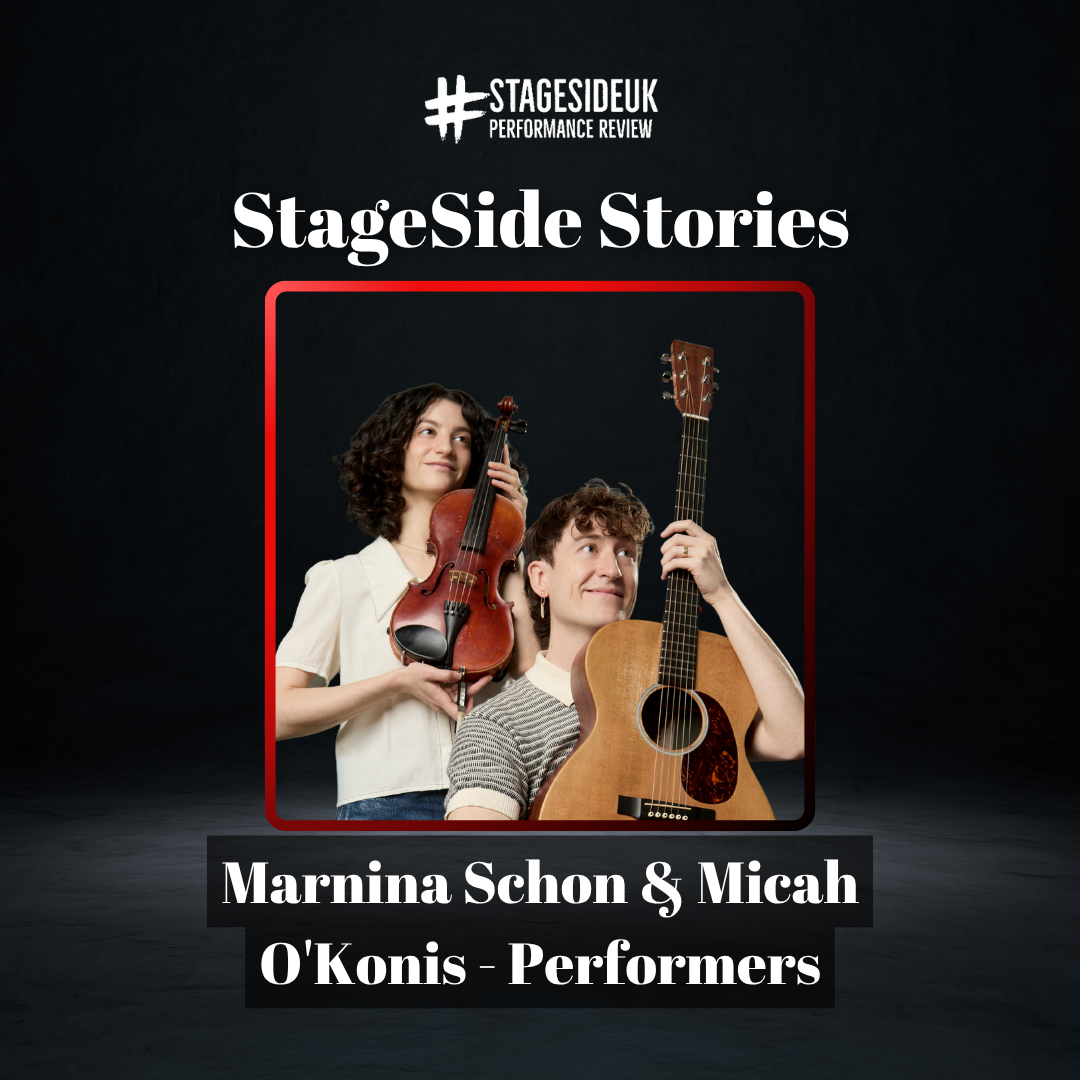
Calling all StageSiders, welcome back to another installment of StageSide Stories. This time around we are talking to two performers, Marnina and Micah, who are taking their show Folk Marry Kill to the Fringe Festival. So settle in if you want to learn more about taking a show to the fringe, turning your life events into material, and how to work with your loved ones.
To begin, could you both introduce yourselves, tell us a little about Couplet, and what audiences can expect from FOLK MARRY KILL?
We’re Marnina Schon & Micah O’Konis. We’re both a couple and a band, which is a pairing that always works out. We’ve been together over ten years as a couple, but in the pandemic we had no choice but to finally start writing comedy songs together and putting them online. Our songs are often about relationships or existential questions, almost always accompanied by just our guitar and violin, and never not true. Audiences frequently remark about how vulnerable, authentic, and relatable we are, and one person at a gig at a British tennis club of all places told us our voices were too good for comedy (not sure what to do about that). Folk Marry Kill is our second full hour we’ve written, and people can expect to laugh a lot, to hear loads of new funny songs (and a small taste of our hits), and maybe feel some feelings about mortality and what forever really means. Also we get the audience to collectively play the game F*** Marry Kill, which keeps the show fresh for us!
The show is inspired by over a decade of *monogamy (and a year of marriage). At what point did you realise your relationship was becoming comedy material, and did you worry?
Ha! We didn’t worry… but now that you ask, maybe we’re worried now? When we started writing funny songs, we found that people really related to them the more specific we tried to get. “People Think We’re Straight But We’re Not Straight” went viral, even though we wrote it to explain what we thought was a very unique dynamic. In writing our song about our experience with a bizarrely bad couples counselor, “Jacquelyn Denfark,” we realized that our people-pleasing tendencies made our interactions with her much funnier. There are funny elements of every relationship, we just learned how to write songs about them. And we love laughing at ourselves, and we’ve realized it’s best to lean into that.
You write and perform together as a couple. What’s your creative process like when you’re developing a new show?
We go through a several-month process of writing a song a week, trying to be inspired by everyday life, about everything from “Bins Day” (the day you get the bins) to writing an ode to the man who narrates our sleep hypnosis. When it’s time to put the show together, we look at all the songs, the themes we’re exploring, and pitch back-and-forth different titles that could pull it all together. Title-first writing helps us stay focused.
Then we put all the songs, jokes, and stories onto notecards, and try out different orders, seeing how we can flow through them. Often in that process we realize what’s missing and what needs to be cut to fit one hour. We talk through arcs for our “characters”, which are absolutely us but slightly simplified and/or exaggerated.
For this show, we were very lucky to work on this process with our good friend and collaborator, director/writer/producer Katie Lindsay who specializes in developing new works in LA and New York. She was the one to say we needed a new climactic song that hits on more emotional profundity than we originally had in the show, and the song we then wrote is now a lot of people’s favorite piece.
Finally, we workshop the show in pieces at different mics and friend shows, because you have to put it in front of audiences to see what’s working and what’s not. In the first full workshop for this show, we had built our ending around an audience vote that went the exact opposite way we thought it would… We tried to improvise through it but eventually fell apart. Hilarious, but what we have now is better.
Your work blends musical comedy with stories that feel wonderfully specific and personal. How do you decide which real-life moments are worth turning into songs?
Wow, what a lovely question! We choose our song ideas based on what gets us the most worked up when we’re telling our friends. Sometimes, in the moment, we’ll even turn to each other and say “that should probably be a song.” We aren’t always right! There was a song about getting trapped in a park in Paris that we were sure would be a hit, but when we wrote it out, it didn’t really have any jokes or point to it. Maybe we’ll come back to it.
How do your backgrounds as classically trained musicians shape the comedy you create today?
Obviously we use music as the vessel for our comedy. But our music training makes us sensitive to the rhythm of the jokes and the phrasing and dynamics of the piece. The classical training also taught us to spout pretentious B.S. like that. In reality, it can make us quite obsessive about little details and exact word choice and scansion. We do a lot of rewriting. And we’re jealous of comedians that improvise entire sets, the ones who feel like loose cannons. Our cannon is more like Pachelbel’s.
FOLK MARRY KILL explores marriage, commitment and the wonderfully absurd parts of long-term relationships. Why do you think those themes resonate with audiences?
Usually in a couple, one person is a Marnina and one person is a Micah. We also have parts of our show that aren’t just for people in relationships, like our pop-folk song “Posture” about optimization culture and wanting to be perfect. And everyone can relate to the human experience of realizing you and everyone you love will die someday. And everyone needs to laugh about that!
Having toured internationally over the past year, have you found audiences in different places laughing at different moments, or is there something universal about the show?
Yes and yes. Some audiences are more prone to laughing, some more to getting choked up, some are faster to play the game in the show or sing along. British audiences tend to like darker and drier stuff and clever wordplay. Thankfully, our act always works as a show, because even if they’re not laughing, at minimum, they’re treated to a very nice concert with very strange lyrics.
You’ve described yourselves as always singing in harmony, even when you’re arguing! Has working together for so long changed the way you communicate creatively?
Yes, we’ve definitely gotten much better at sharing our thoughts with each other when we would’ve previously been scared about hurting each other’s feelings. When it’s something as low-stakes as comedy, disagreeing can help us practice for something that actually matters. And we have to confess, we do sometimes argue unharmoniously, especially about getting out the door.
Edinburgh audiences love discovering shows that surprise them. Without giving too much away, what do you think people will be talking about after they’ve seen FOLK MARRY KILL?
Is it tacky to share some audience review quotes here? Uh oh, we’re doing it!
“Literally my partner and I have not been able to stop talking about it, there were so many things Marnina and Micah brought up in their show that my partner and I had felt in our relationship but never had the words (or melody) for.” – Z.S.
“Especially in the context of Fringe, this is a palate cleanser that shows a little heart and melody goes a long, long way.” – B.B.
“The songs are infectious and brilliant, both lyrically and musically, beautifully performed, and woven into a deep and funny and honest narrative journey that Micah and Marnina paint not just FOR us, but WITH us. A dream of a show! Go see it!” – T.S.
“Get ready to laugh uncontrollably, listen intently, think a lot about death and love, and… play a riff of a game adults like to play with friends. All in all, a truly unforgettable comedy & variety act that only they could create!” – Larchmont Buzz
Finally, if you could each give one piece of advice to aspiring comedy writers and performers, what would it be?
We often say to each other, “writing is writing.” It means you can ideate and talk back and forth about an idea, but even if you still don’t have something good yet, you need to write whatever you have down to get to where it’s good. Also use people (not AI) to test out what’s funny! Get in front of live audiences at mics and local variety shows. Try it out with trusted friends. Put stuff on the internet, even in rough form. The worst case is that no one sees it, which only means that no one is seeing you fail. So just throw it up there!
Thank you to Marnina and Micah for talking about their show Folk Marry Kill and preparing for Fringe. It has been really interesting, learning more about the process and how to create a show from personal experiences.
Have your say
Are you thinking of taking a show to the fringe? Are you studying music, drama or performance at college, University or Drama School? How are you finding the process, and do you have any tips?
Let me know in the comments!
If you are interested in being featured in the next installment of StageSide Stories, then please do reach out to us and we would be happy to discuss this with you.
As always, please be respectful of each other’s opinions and be kind to each other.
Bullying will not be tolerated and harmful language may be removed. Head over to the Terms and conditions page to learn more about our policies, here at StageSideUK.
Follow us on Twitter and give our page a like on Facebook.