

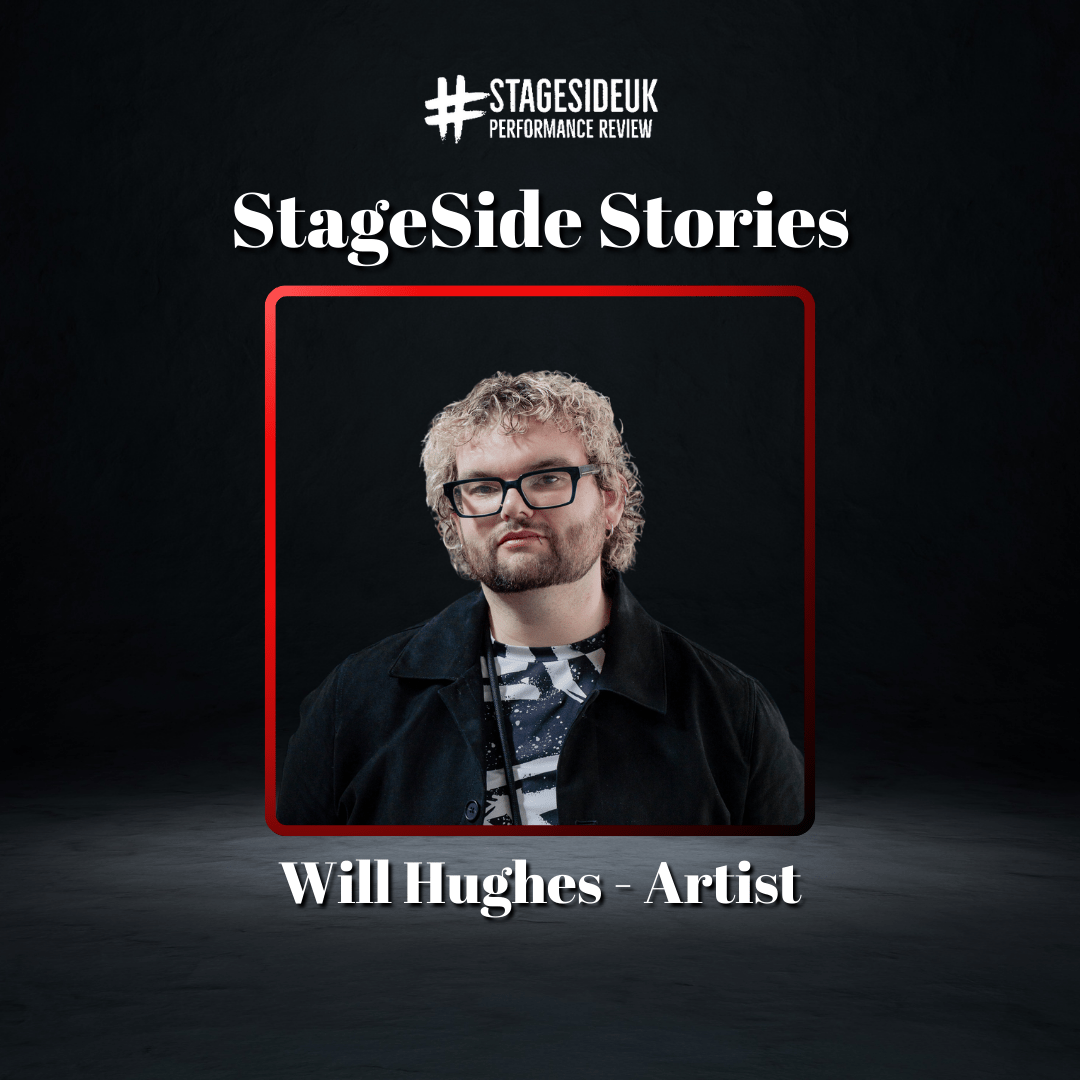
Calling all StageSiders, welcome back to another installment of StageSide Stories. This marks the first installment of the year, and what an installment it is. In this interview we talk to Will Hughes, a queer artist based in Stockton on Tees, who currently has an exhibition on in MIMA in Middlesbrough. So make a brew, and lets learn about the life of an artist here in the North East.
This interview was conducted by Jonathan Harper, facilitated by Chloé Nelkin Consulting.
To begin, could you introduce yourself, your practice, and the work you’re presenting at MIMA?
Hey, my name is Will Hughes and I’m a queer artist based in Stockton on Tees and I have my studio at Platform Arts in Middlesbrough.
The work I’m presenting at MIMA is part of Desire Lines: Art, Place & Possibilities. The solo presentation that I have produced with Helen Welford and Danni Ash is titled Glamour, Desire and Queer Materiality. It explores a blend of pop-culturereferences with a variety of materials, looking at how objects’own histories can be used and built on to tell narratives. In the show, these narratives take the shape of exploring intimacy, belonging and aspiration as someone who grew up in social housing, but was always drawn to celebrity, music and athletics.
You’re one of the Tees Valley Artists of the Year 2025, what does that recognition mean to you at this point in your career?
I have learnt that a career is not built on one moment, it’s built on all the small and big things stacked together. All the experiences in-between that create momentum and drive my practice forward. I applied in 2024 for the award and got through to the interview stage, but ultimately they went in a different direction. As you can imagine, when I was selected in 2025 I was over the moon.
I feel the award recognises the steps that I’ve taken and the cumulative effect of being present in the arts scene locally, nationally and sometimes internationally. I actually cried when I got the news because the financial side of the award – a grant for a living wage – is transformative for the year and can help me build a really strong platform to look to the future.
Your practice is often described as concept-driven and closely connected to lived experience. How does that shape the work audiences see in this exhibition?
This is a great question! I am definitely influenced by my own experiences and often I’m trying to portray a moment or an emotional point in my life. Sometimes these moments are joyous but at other times challenging and difficult. I often refer to myself as the Lana Del Rey of the art world.
One moment in the show I would like to tell you about is in the work ‘The air that I’m breathing, Forever’snot enough’(2025). In this piece, two plastic bags slowly inhale and exhale within the gallery space. Installed in dialogue, the sculptures highlight the choreography of intimacy and the fragility of desire. Made from glittered plastic and powered by USB fans, they echo the shared rhythm of breath. In this work I’m reflecting on the intimacy of breathing and being in sync with another person, as well as the effort required to sustain closeness. The work is titled from the song‘Bladeof Grass’, a 2025 song by musician Lady Gaga.The sculpture uses repetition and synthetic materials to explore my want for human connection.
The exhibition title suggests ideas of movement, place and possibility. How do those themes connect to your own relationship with Teesside and Middlesbrough?
I’m an immigrant to Teesside and Middlesbrough, and the wider exhibition at MIMA talks about the fact that Middlesbrough is a town built on migration, it didn’t exist even 200 years ago. I moved to Teesside for a cheaper art studio and worked in a Sainsbury’s local in Eston for a while. The studio I got was at The Auxiliary which had a vibrant collection of artists in and a really strong group of queer artists – I really felt at home. This sense of community has been around me ever since, across the whole cultural sector. I hadn’t lived in a place that felt so friendly and supportive. The arts organisations want to help artists and most importantly the artists want to help each other to grow and succeed. Cliques and protectionism which I have felt in other areas is replaced with warmth, cheering each other on and a belief that success and opportunity is a group mission.
It’s also been a place of opportunity for me. For just over 3 years I worked with The Auxiliary and Middlesbrough Art Week as a project manager, which I absolutely loved. In that role I built up my skills as a curator and a project manager. From this and with moral support from Navigator North, TVCA and financial support from Creative Factory and Arts Council England, myself, Bobbie Bailey and Eve Cromwell have been able to set up SAWDUST CIC, An Artist and community-led creative placemaking & fabrication studio. We will be giving artists the tools to make work, as well as working with community groups on projects to improve their own environments. The centre piece to our workshop is a CNC machine which we will be able to use a computer to tell the machine to cut shapes out of wood up to 8×4 foot. We want this to be an accessible space for artists and are looking at a membership model which will remove some financial barriers to accessing equipment and create a space to create artwork. For me Middlesbrough has been a place I’m able to dream in and dream big! And we want to allow others to dream too.
This is a solo presentation within a group exhibition. How did you approach carving out a distinct voice while sitting alongside other artists’ work?
Through conversations very early on, I talked with the team at MIMA about how important space was for me. My work is minimal and for it to be allowed to sing it must be allowed to breath. I felt listened to and MIMA was great at understanding my point of view. The space I have been given is a large rectangular gallery which we have dimly lit and uses spotlights to pick the works out from the white walls. The room feels soft and the show in my head when designing it was much harsher with bright light, but in the end a softer feel was what felt right. I enjoy it when a show surprises me and gives me a new perspective, even when you have lived and worked on the pieces for so long.
What role does identity play in this particular piece, and how much do you want audiences to know going in, versus discovering for themselves?
Wow, we are going in deep with this question which I love! I hide so much of myself within the works behind material choices, surface finishes and the use of ready mades in the production process. My identity as a queer non-binary person is in all of the works – my experiences shape everything I touch and those materials also shape me.
The titles also offer clues by using lyrics that people may recognise to reflect my state of mind at the time of making. But I would not say I’m trying to dictate a viewer! To a certain point of view the works may look simple and minimal, but I’ve been through a process of reduction in the making process, removing unnecessary clutter to produce these moments. I know how I felt in the moments I’m recreating, but I’m not asking the viewer to look at the work and experience what I felt making it because that’s impossible – we are all individual. I’m asking the viewer to interrogate the surface and build your own story around the connections you make and around your experiences. I’m asking the viewer to look beyond.
I feel that a queer or a global majority person would know the feeling themselves of walking through public space with an averted gaze, unwilling to meet others eyes. Adopted in an act of self-preservation, this stance is shaped by a fear of judgement and the realities of being seen. And this is a feeling I express with the work ‘And I’ve been through so much, that sometimes it feels far. It is like a movie, played by another star’(2025). But that feeling could be universal, and I’m sure anyone who comes to the show will be able to relate in some way to a work In the show.
For me representation matters and to be a working class, queer non-binary artist showing work in MIMA, where I live and call home, is very important to me and allows people to see possibilities and futures where they might have not before.
Can you talk us through the development process for this work? Where did it begin, and how did it evolve into what’s now on display? What’s it been like seeing your work presented in a space like MIMA, and how does the gallery context affect how the piece is read?
I was actually worried when I was approached, as it’s daunting to know so many people are going to view and have an opinion on your work – both good and bad. But I tried to block all this out and put together a show that I was proud of and felt was honest to my way of working. For the most part, I think we got there with the show, but with everything we do never feel fully satisfied and yes, there are things I would change and areas I’m not fully happy with, but I will grow from this experience and it will allow me to make the next show better again.
I love the word affect because it talks about emotions and that is something that is very much a part of my practice. The gallery that I’m in is a white cube space and being devoid of architectural detail allows the work to be uninterrupted. Having shown in many non traditional gallery spaces, shops, run down buildings etc, I find I thrive on making a connection with buildings that have a history in the architecture. The work and the building exist in juxtaposition or harmony but they do affect each other. With MIMA I had a big challenge, hanging work on white clean walls isn’t easy – this is where the curation and lighting came in. Myself, Helen, Danni and Martin worked together on the lighting to bring the work to life on the stark walls. With the loan of a stage light from Artistic Solutions, we were able to add a sense of theatre and that is when my confidence returned.
What do you hope visitors take away from spending time with your work?
Most of all, I hope that they take a breath and a moment. Many people may be intimidated by conceptual art, but if you think it’s not for you, I want you to take a moment to look at one of the pieces and unpick what you can see, empty your mind and look for clues in the colour, textures and movement. Do you recognise something but is it out of place from your everyday recognition of where it should be?
I often think of conceptual art like a puzzle.
Finally, if you could give one piece of advice to an aspiring multidisciplinary artist, what would it be?
Don’t let anyone tell you being an artist isn’t a career – you can survive and thrive in it! You will have to work other jobs in retail, hospitality or social care, but these jobs will inform your practice and allow you to grow your practice slowly. It’s not a race! Build your practice up little by little. You don’t have to have a studio. Apply for that group show or residency opportunity, but be selective and look at judging panels, and only apply to opportunities that feel relevant to you.
Be yourself, go to exhibitions and talk to people.
A big thank you to Will for sharing their experience as an artist, with an active exhibition in MIMA. I got to see the exhibition and can say it is definitely thought provoking and I can really see those connections between heteronormative and queer experiences.
Have your say!
Are you thinking of starting a career as an artist? Are you currently working on a new exhibition? How are you finding the process, and do you have any tips? Let me know in the comments!
If you are interested in being featured in the next installment of StageSide Stories, then please do reach out to us and we would be happy to discuss this with you.
As always, please be respectful of each other’s opinions and be kind to each other. Bullying will not be tolerated and harmful language may be removed.
Head over to the Terms and conditions page to learn more about our policies, here at StageSideUK.
Follow us on Twitter and give our page a like on Facebook.