

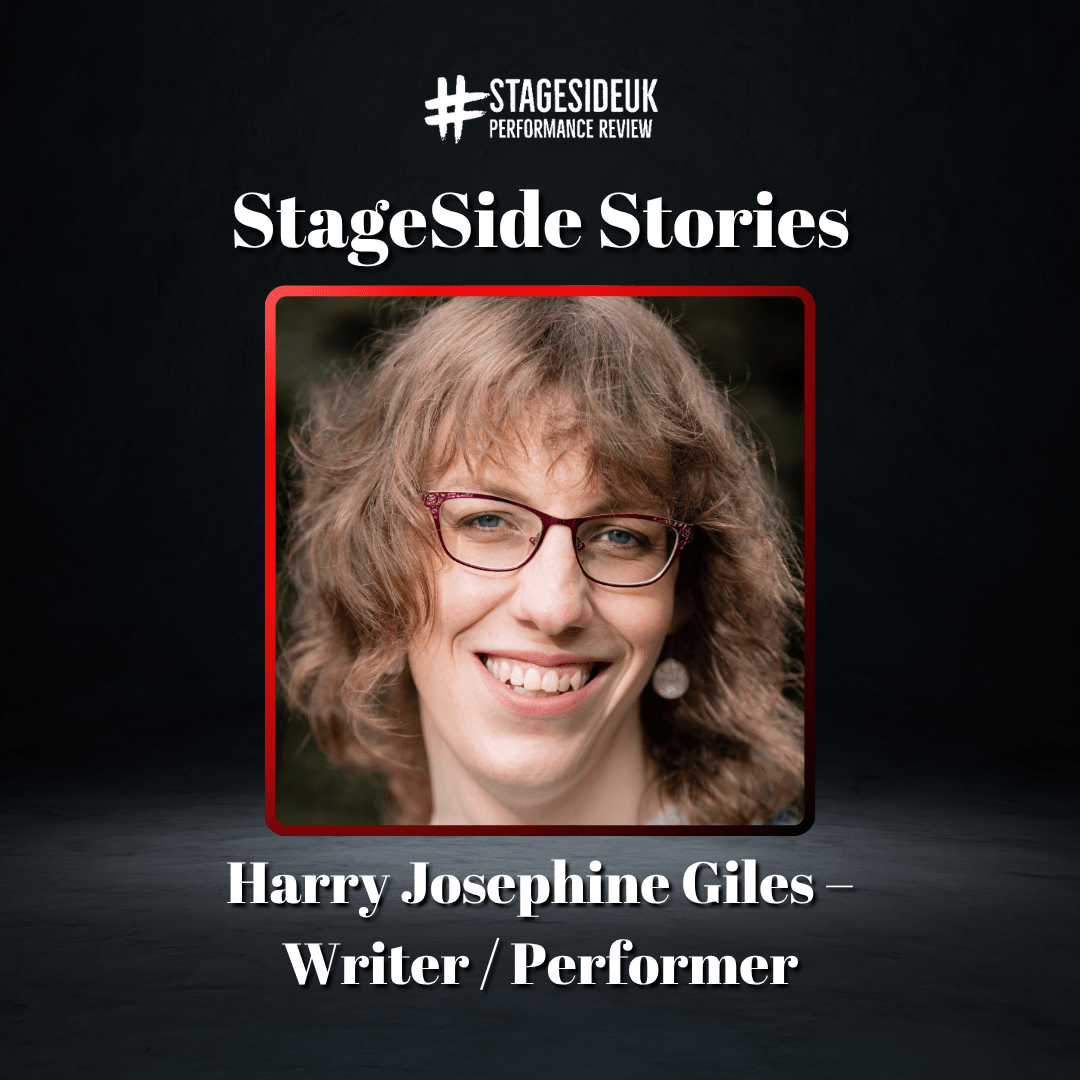
Calling all StageSiders, welcome back to another installment of StageSide Stories. This time around we are hearing from Harry Josephine Giles, and discuss all things performing, writing and adapting work for the stage. If this sounds interesting to you, settle in and lets get started!
- Can you introduce yourself and your role(s) within this show?
Hello. I am Harry. Josephine Giles. I’m a writer and performer, and I am also the writer and performer of this show (Deep Wheel Orcadia). So I wrote the book and I perform the text and the show. The show began life as an award winning, yes, I did an award winning verse novel.
- Deep Wheel Orcadia began life as an award-winning verse novel—what inspired you to adapt it for the stage?
It was actually always thought about as a stage, as something that would live on the stage as much as it lived on the page. When I say I’m a writer and performer, those two things are intertwined for me. My poetry is often, if not almost always, oral as much as written down. I come from an oral culture, and performing poetry matters as much to me as writing it, or rather, performing it is a way to write it. So I’ve been working with Atzi, the cellist and composer for this show, since I was writing the novel, like we’ve been working together on this for maybe around seven years, and we were always thinking about forms of stage adaptation before the book was published, while I was writing the book.
So actually, the stage show and the book have evolved together, even though it’s taken a bit longer to get the stage show to completion. It’s a couple of years since the book was published, but this is the stage show coming to completion now, but I’ve been imagining this show since I was writing the book.
- How did you approach the process of transforming a written, poetic work into a fully realised live performance?
So this will be the third or fourth performance that I’ve made that is like intertwining poetry and music. I’ve developed a methodology over a number of years of how to do this, and central to that is collaborating with musicians from early on in the process, and so that the way that musicians respond to my writing can inform what then gets written. I’ll bring early versions of a work to a musician, hear how they respond to it, and then respond to their response, and how the music that they come up with can then influence what I’m writing, and what I’m writing can then influence the music they come up with. So that’s an important form of iteration that makes it happen.
And then another form of iteration that makes it happen, which is really how I’ve made every show that I’ve ever made, is I start by making a small version of something, and then I’ll make a slightly bigger version of it, and then a bigger one. And so the first performance of this was probably 1015 minutes long, and then we did a half hour version that was just me and Atzi, and then we did an hour-long version that was me and a string quartet. And now we’re doing a version that’s all of that, with direction, with movement, with staging, with design. I don’t know how common that process is in the theatre. I think it’s increasingly common for sort of funding related reasons. I like it creatively. I like developing something over a course of years and letting it grow over time. I find that a very exciting process.
It’s something that allows, I think, for multiple stages of collaboration and for different inspirations to come in over the course of making something in a kind of slow and growth-oriented way, like not growth as in, like economic growth, but growth as in a tree.
- What was most important for you to preserve from the novel’s spirit when bringing it to theatre audiences?
The centrality of language and linguistic play and linguistic experimentation that is central to the novel, that it’s, it’s, it’s not just a novel, it’s also a set of ideas about what you can do with language and how unstable language and translation are. You know, the book is written in two languages, and they interact with each other in slightly confusing ways, and we’re bringing some of that to the stage as well. And that’s really important to me, is that this isn’t just it’s not social realist theatre. It’s something that is about how story and language work.
- How involved have you been in the creative staging, beyond writing and performing? Has collaboration with the director, Susan Worsfold, shaped the work in new ways?
I would say that Susan is somebody who wants to bring ideas out of other people, and who is able to bring her own aesthetic ideas, her own concept, but is really interested in supporting structures of imagination. Let’s see. And so, yeah, like my own ideas, my own thoughts and imaginations have been part of how the staging has developed. But also for me, something that’s important is knowing that I’m a writer and performer, and those are my specialties, and what I really want is for designers and musicians and artists of other kinds to bring their own specialities in and interpret my text in their own ways. So I’ve shared some of what’s important to me, but I’ve also really wanted the other artists to bring their own ideas to the work.
- The show is performed entirely in Orkney Scots with English surtitles—an exciting choice. Why was it essential for you to keep Orkney Scots at the heart of the production?
Because that is the main language of the book, because it’s a minority language, because minority languages, by definition, are often sidelined. So this is a chance to bring minority language centre stage in a way that rarely happens in theatre in Europe and in Europe settler colonies, which are, again, definitionally majority language institutions. And so English is sidelined here. English is minoritized, and the audience is going to be present to Orkney Scots as the main language of the production and the thing that this story is happening in, and that’s a move that asks people to consider, what happens when majority minority language is central in our lives.
A huge thank you to Harry Josephine Giles for answering the questions above, and for giving us such an insight into the role of a writer and performer.
Have your say!
Are you thinking of starting a career as a writer or performer? Are you currently studying writing or performance at University? How are you finding the process, and do you have any key techniques, tips or skills to hone? Let me know in the comments and lets get a discussion going!
If you are interested in being featured in the next installment of StageSide Stories, then please do reach out to us and we would be happy to discuss this with you.
As always, please be respectful of each other’s opinions and be kind to each other. Bullying will not be tolerated and harmful language may be removed.
Head over to the Terms and conditions page to learn more about our policies, here at StageSideUK.
Follow us on Twitter and give our page a like on Facebook.
Featured images have been referenced and are used in line with fair usage, in the copyright act.