

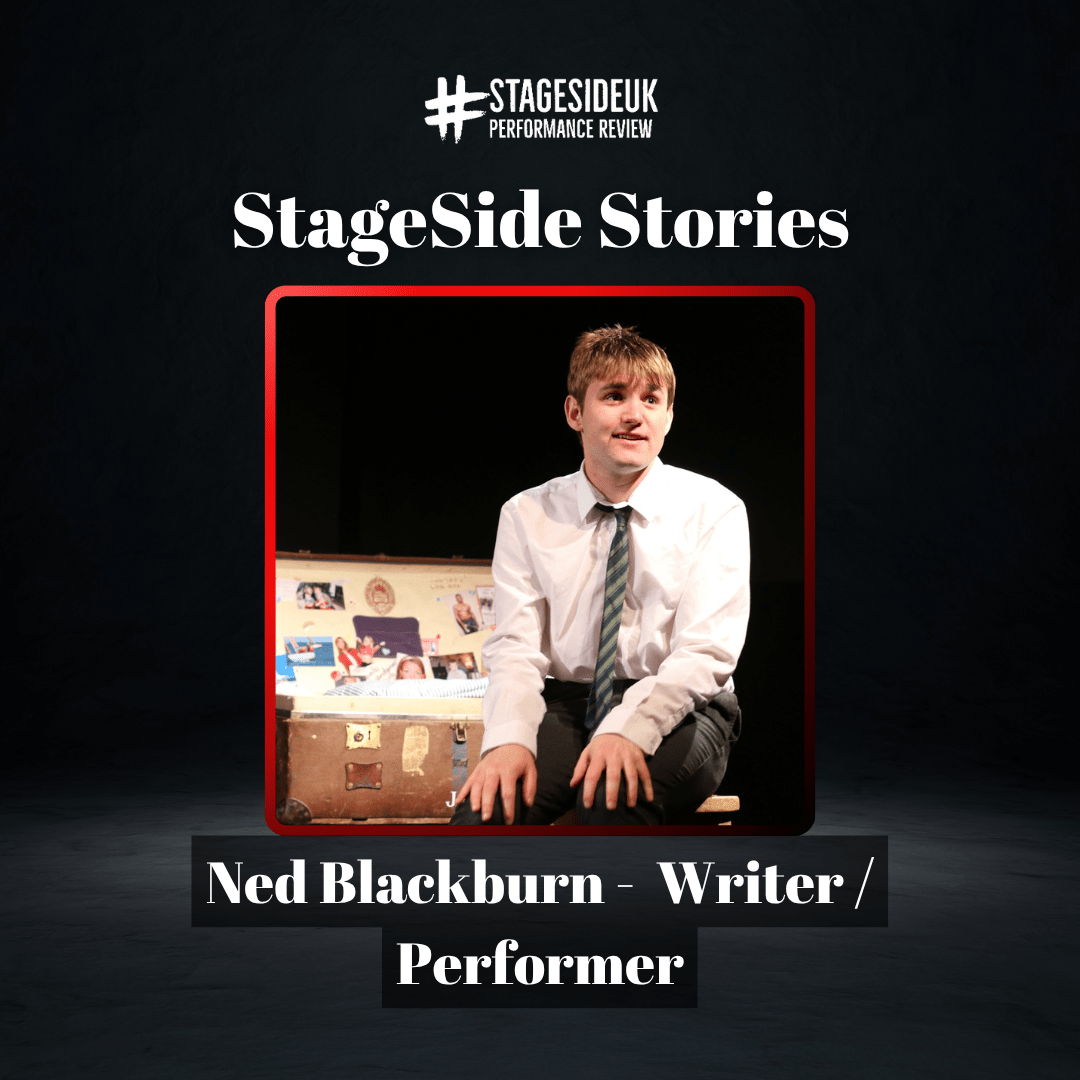
Calling all StageSiders, welcome back to another intsallment of StageSide Stories. This time around we talk to Writer, Performer and member of Choir Boys Productions, Ned Blackburn. We talk all things theatre, writing, political theatre and queer arts. So keep on reading to hear more from Ned!
Please could you introduce yourself and your role?
I’m Ned Blackburn, I am the writer of and play Johnny in An Adequate Abridgment of Boarding School Life as a Homo. I developed the writing and production of the piece with our team, Choir Boys Productions, made up of Josh Stainer, Meg Bowron, Lizzie Hawke, Harvey Weed and Will Walford.
The title alone—An Adequate Abridgement of Boarding School Life as a Homo—sets a tone that’s both tongue-in-cheek and deeply personal. What made now the right time to tell this story?
I think on a personal note, it was the right time because I’d met a group of creatives that I wanted to tell the story with. I met the Choir Boys team through working on plays through the Drama Society at Manchester University, and some of the team were graduating so I think first and foremost I wanted to keep them around- it was perhaps a little coersive! But I think I have also reached a point with the play that there is enough distance between the play as a piece of writing and the more personal bits, it’s been distilled over the years we have been working on it and so now, with the support of the rest of the team, feels like the most opportune time to present it to audiences.
How did the idea for the show first come about—was it a slow-burn reflection, or did it arrive more urgently?
It did arrive quite urgently. During the (trigger warning) lockdown period, I started writing a lot, which I’d not really done before and after trying my hand at more outlandish and whacky stories that to be honest didn’t make a whole lot of sense, I considered the advice to “write what you know” and so I just went about trying to take a comedic and dramatic look at experiences that had happened to me or friends or stories that I’d heard along the grapevine. The actual writing took a while, though, and that initial idea has taken many twists and turns, the script remains fairly messy with several typos and grammatical errors- I’m not sure if we’ll ever get there!
Writing theatrical work can be both cathartic and exposing. What was your relationship with the core themes while creating this piece?
I was very intertwined with the theme of shame within the play. I was very nervous that a sexually active, young and queer character would read as cringe and crude, and I think that was because I thought when I was at school that if I came out I would be seen as dirty in some way. Throughout the writing and performing of the show, I’ve realised that it just isn’t the case, firstly, I’ve got a fairly tame imagination when it comes to the sexual parts of the story and so what I thought would come across as a Basic Instinct style scandal has turned out fairly PG (give or take a few scenes). But secondly, people aren’t that simplistic, audience members certainly aren’t and neither are the characters of straight men and bromosexuals, everyone is contending with their own desires and sense of identity and their reactions are often surprising.
How do you balance the emotional weight of your material with the moments of humour that the title suggests?
Hopefully, we do it by playing true to both. It’s a funny set-up, a gay man in all all-boys boarding school, and so while it’s by no means groundbreaking comedy, there is something comforting in the humour that has developed in the show because it’s often a coping mechanism and that’s a very human thing. But there are of course, many moments when that coping mechanism falters and life becomes a little bit more bleak. We tried to place emphasis on both parts of the show: the funny and the emotional and find a natural balance between the two.
Can you talk about the structure of the piece and how the show came together, as it is now?
The play centres around the character of Johnny, a gay man in his last year of an all-boys boarding school. The play sees him interact with a cast of other characters like the school’s headmaster, an awkward PSHE teacher, Grindr users, and his love interest Harry. All these characters are played by Harvey Weed, and they are, a lot of the time an extension of Johnny’s imagination; it’s his story which he is telling to the audience but he is sometimes interrupted by the other characters who force him into the reality of his situation.
I wrote the play as a one-man show to begin with. That was the version that the team read first and while it could have worked, it would have been a very different final product. I re-wrote the play almost two years ago, after Meg (co-director) and I had just finished a run at the 2023 fringe with a uni sketch show. Maybe I was just in the sketch show mindset and had watched one too many one-person monologues at the fringe, but I thought that comedy dramas can be so much more successful when there is someone else outside of the main protagonist to land the punch lines and build tension.
Meg and Josh (the directors) are the ones who really built on the structure, they created the world of the school around Johnny. The characterisations of all of the multi-rolling characters are left fairly open in the play, so it was really their vision combined with Harvey’s performance, that landed us in this distorted world with an unreliable narrator at the centre of it.
How much of the show is scripted, and how much space do you leave for spontaneity, improv or audience response?
All of the show is scripted. I really admire people who can improve and be spontaneous each night, but it’s not really my skill set. It’s been really helpful to rehearse each monologue and interaction with specificity as it’s allowed to be really comfortable with the material as it a bit of a jigsaw with many props, transitions and cues. That being said, Harvey and I do interact with the audience quite a bit (not physically if that sends of any alarm bells to potential audiences), so there are always going to be things that happen spontaneously, it just depends what energy we’re getting back and often who is sat in the front row.
What were your biggest inspirations—literary, theatrical, or otherwise—when shaping the aesthetic of the show?
First and foremost, I wanted to impress my friends, I had admired the taste level of the creative team (Josh, Meg and Lizzie) so I was mostly spurred on by wanting to write something that they thought was good. But Miranda Hart was definitely a big one, and I know that’s not the most original of answers but I don’t really care because I just love her! I think the humour of the character of Miranda is synonymous with the feeling of being a bit of an awkward bumpkin and that is so equally endearing and funny. Waiting For Godot by Samuel Beckett features quite a lot in the play, which is one of the texts I studied at A Level, on the surface it’s another two-handed play about identity and waiting for something to arrive, but on a deeper level, I’m not sure as I never really understood the play so I guess it’s a bit of nod to confusion and conceited storytelling. Our story is a bit more overt and less shrouded in meaning but the themes of it are open to interpretation, so I like having a nod to another story that can have multiple meanings and may take a few years to digest.
You are both performer and writer for this piece, do you feel that, as you perform the piece the tone, language or structure changes?
It’s always going to change a bit as lines often escape me, so I’m always on my toes trying to cover up slip-ups. But also since having a while between our original Edinburgh Fringe run last August and the run we are currently in the middle of, I’ve got more of a handle on the tone and beats of each scene, that’s definitely come from talking to people that have seen or read the play and from practicing around the house. We have re-written bits of the show, since last summer, which has been really fun because collaborative writing is often my favourite way of working, I think the re-writes have toned down bits of the play that were sometimes too poetic and retrospective. Trying to find the balance between the monologues that see Johnny in control of his story and identity, and the scenes where he is not in control and is forced to confront harsh truths has always been our main aim, and so a bit of feedback and time to mull the play has been really helpful in unravelling the heart of the story.
There’s something really powerful in speaking so frankly about queerness within the very controlled, often conservative world of British boarding schools. What was most important to you to expose, discuss or reframe?
The play was never really about exposing, boarding school is a well reported and depicted setting in tv shows, tabloids, books etc to the point that the setting itself is now fairly low-hanging fruit. So our way into the setting was through the lens of a gay-character; the school and its masculine ethos has to contend with someone (who even if only privately) rejects its traditionalism and heteronomarivity, rather than the other way around. Whilst my experience of school was the research for the play, we’re not trying to create a realistic depiction of an elitist school, we are more interested in something more personal that hopefully depicts relatable experiences for people who are at odds with the world around them.
British theatre has a long and complicated relationship with class and queerness. Do you see your work as pushing back against particular theatrical traditions or tropes?
I think the humour of the play is very much of its origin, a gay man’s wit that is often formed around camp, it is both a theatrical tradition and a trope, but I do think that’s because gay people are funny and are now allowed to be the ones openly telling the jokes that are accented with limp wrists and piroutes. I think in terms of class, we try to be quite overt with the story and not try and shroud the play in mystery, like a lot of uper-class stories do, stories that often overpromise a level of relatability that can’t really be offered from a setting that is quite unrelatable. There was a section in first draft of the play that functioned as an apology for privileged education, but it didn’t work and so from a group consensus we cut it and instead trusted that the struggles for identity and acceptance can be universal while still encompassing of the overly inflated sense of entitlement that fuels private schools. We’re also very stubborn on the fact that it isn’t a coming out story, it’s doesn’t use sex for shock factor, and it’s not tragic, queer theatre often has to be packaged into one of those boxes and so I hope our defiance of that comes across.
Were there aspects of boarding school culture that felt especially perfect for satire—or especially resistant to being laughed at?
The teachers for sure! Harvey and Will Walford (who played the role in the first run of the show) are both satire geniuses and pulled a number of references that heighten the characters found in a boarding school to the point where they are both accurate and bizarre.
The bit that was resistant was maybe the homophobia, because it hasn’t really changed. All-boys schools are still a big presence in this country and the prejudicial behaviour found in these schools has not gone away it’s just different. I think that calling someone “gay” is no longer a slur that infers disgust and repulsion; it is just the quickest way you can insult someone, but that doesn’t make it any less homophobic. Portrayals of homophobia are often funny, because they reflect on dated attitudes, yet bullying of young queer people is so prevelant in schools. I think that homophobia is so synonymous with boarding schools because they are the ultimate harbourers of traditionalism and just because modern society advances in its attitudes towards queer people doesn’t mean that they have yet or intend to. And of course on top of that, queer people are so often the centre of culture wars in this country, so elite schools that claim to be a-poltical and have long forged ideals, feel that they can remain stagnant in their pastoral approaches and do not have to accommodate pupils who do not align with a school’s gender ideals, heternomartive enviorment and general atmosphere that doesn’t support people who are different.
What conversations do you hope the show sparks among audiences—especially those who may never have encountered either the boarding school or the queer world?
I hope there’s enough within the story to fuel a post-show pint conversation about identity struggles and shame, and maybe a few compliments about my Britney Spears choreography. There are many stories that are similar to this one, a coming-of-age narrative narrated by someone with similar experiences to the character, but I do hope that it can be good thing, a welcome addition to a conversation about finding acceptance and holding compassion, often rare things.
What have been the most surprising audience reactions—either during or after the show?
The most surprising was a letter that we received at fringe last year, that was sent by an audience member from America. They had seen the show while on a school trip to Edinburgh and had related to a lot of the themes in the play and was finding their time at school difficult. I was always excited at the prospect of friends and family getting to see the show, but I hadn’t really thought about the strangers that might be in the audience, so to receive a letter from someone from a different country and was in an immediately relatable situation was so humbling and it remains a true highlight of the whole experience.
What advice would you offer to other queer artists looking to bring their lived experience to the stage?
Find a team that you trust and trust them. You should always have confidence in yourself, but on the occasions when that confidence might falter, having a supportive group around you will make all the difference. Lived experience will always be a tenuous resource when working towards a production, and that’s not a bad thing, if you remain true in sentiment, then you can rely on people that you admire to bring their own creativity and passion to a project and that is often the best creative decision you can make.
Looking beyond Adequate Abridgement, do you see this as the beginning of a longer creative arc for you—are there more stories from this world still to tell?
I think for me the world of boarding school remains fairly self-contained as a souce of inspiration, and I think for now I’ve squeezed the majority out of that orange. There’s definitely lots more queer stories to tell and I am eager to be a part of some in whatever role I can wrangle.
And finally—if you could give one piece of advice to an aspiring writer or performer, what would it be?
That you can learn by doing. Putting on theatre at the moment feels like a list of problems. There are big problems that require solving by people and buildings that have the opportunity to remove barriers to entry. But while these problems remain unsolved, the smaller problems are the ones faced by early career producers, writers, directors, performers and designers who contend with immediate questions like where can I stage this play, where can I get funding and how can I transport a massive set piece in a Kia Picanto (personal experience)? And it is the solving of these smaller problems that often leads to the best kind of theatre, because it is made by people uncompromisingly passionate about their work and that translates to an audience. There is no criteria or required experience for this kind of theatre making, so shoot your shot!
A huge thank you to Ned for taking the time to answer these questions and to Choir Boys Productions for organising the interview. This provided a great insight into the world of taking a show to the fringe, writing theatre and performing in your own show.
Have your say!
Are you thinking of starting a career as a writer or performer? Are you currently studying writing or performance at University? How are you finding the process, and do you have any key techniques, tips or skills to hone? Let me know in the comments and lets get a discussion going!
If you are interested in being featured in the next installment of StageSide Stories, then please do reach out to us and we would be happy to discuss this with you.
As always, please be respectful of each other’s opinions and be kind to each other. Bullying will not be tolerated and harmful language may be removed.
Head over to the Terms and conditions page to learn more about our policies, here at StageSideUK.
Follow us on Twitter and give our page a like on Facebook.
Featured images have been referenced and are used in line with fair usage, in the copyright act.